
Computer Repair
Slow, infected, or won’t start? Let’s get it working again.
Diagnosis and repair for slow, broken, or infected PCs and laptops, as low as $35/hr — with a straight assessment of whether a repair is worth it or a replacement makes more sense. Home customers drop off by appointment (no in-home visits); businesses can get on-site visits; 24/7 emergency help by call or text.

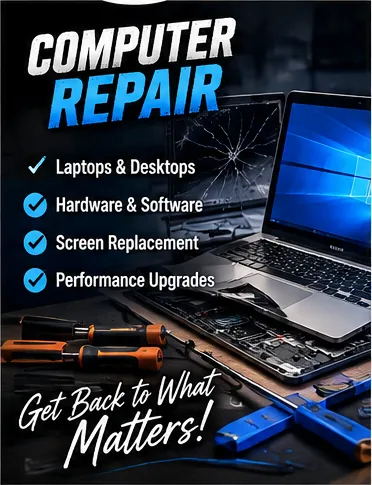

Most computer problems have a straightforward cause, once you actually look. Drop the machine off by appointment (or, for businesses, book an on-site visit), and I’ll find what’s really wrong, tell you the cheapest fix that solves it, and never push a new machine when a repair will do — Windows or Mac, laptop or desktop.
What’s included
- Virus, malware, and adware removal
- Slowdowns, freezes, and startup/boot failures
- SSD and RAM upgrades — your part, or one from my in-stock hardware
- Data-recovery attempts from failing drives (not guaranteed)
- Windows and Mac; laptops and desktops
- Reinstalls, migrations, and new-machine setup
Should you repair it, or replace it?
Nobody wants to spend money fixing a computer that’s on its last legs — or throw out a machine that just needs a cheap tune-up. Lean toward repair when the machine is only a few years old, the fix is cheap relative to its value (a new SSD, more memory, a fresh battery, or a malware cleanup often brings an older machine back to life for a fraction of a replacement), or it’s a software problem — slowdowns and startup errors are frequently fixable without new hardware at all. Swapping a spinning hard drive for an SSD is usually the single biggest speed upgrade a computer can get, and you choose the drive — from my in-stock hardware or your own.
Lean toward replace when the repair cost approaches the price of a new machine, when it can’t run the software you actually need, when the hardware keeps failing in unrelated ways, or when the machine is simply old enough that parts are scarce and expensive. A simple rule of thumb: if a repair costs more than about half the price of a comparable new machine, replacement is usually the smarter money — but a reliable older machine that does everything you need is still worth keeping.
Whatever you decide, back up anything irreplaceable first. A failing machine can lose data without warning. And if you're replacing rather than repairing, don't just hand off or recycle the old machine as-is — see our guide: How to Securely Wipe an Old Computer.
Pricing & policy, honestly
Computer repair is as low as $35/hr, and I confirm the rate before work starts. Estimates are provided up front — you approve the scope and rough cost before anything starts, and no payment is taken until the work is done. This is a one-person hobby and second job, not insured, and not a licensed contractor. Devices left after a completed repair are held free for 30 days, then $1/day.
Data recovery is best-effort; outcomes depend on the failure and are never guaranteed. Keep your own backup of anything irreplaceable.
Questions
Do you pick up my computer, or come fix it here?
For home customers, no — bring the machine to me by appointment; there are no in-home visits. Businesses can get an on-site visit (Seymour, Jackson County, Scott County, and surrounding areas), and remote support is available.
How do I know if it’s worth repairing?
I’ll tell you honestly. If a repair costs more than the machine is worth, I’ll say so and lay out the options — no pressure to spend on a lost cause.
Will my data be safe during a repair?
I take care to preserve your data. That said, always keep your own backup of anything irreplaceable — no repair can promise a specific recovery outcome.
My computer has a virus or pop-ups — can you fix it?
Yes. Malware cleanup is common work. I’ll remove the infection, check for damage it left behind, and help you avoid a repeat.
Why is my computer so slow?
Usually a mix of a full or failing drive, too many startup programs, low memory, or malware. An SSD upgrade is often the single biggest speed improvement on an older machine — you choose the SSD (from my in-stock hardware or your own), and I install it.
Who supplies the replacement parts?
You choose and pay for them. I’ll tell you exactly what’s needed — the SSD, RAM, battery, whatever it takes — and I can supply it from my in-stock hardware, or you can bring your own.
How much does it cost?
Computer repair is as low as $35/hr. I confirm the rate before work starts.
What if it’s an emergency?
24/7 emergency help is available — call or text 812-525-2429.
Do I pay anything up front?
No. No payment is taken up front — you pay when the work is done and you’re satisfied.
Ready when you are.
Tell me what’s going on and we’ll arrange a drop-off appointment (or an on-site visit for businesses) — evenings and weekends, 24/7 for emergencies.